Phrase Match vs. Broad Match vs. Exact Match: Which One Is Right for You?

Phrase Match vs. Broad Match vs. Exact Match: Which One Is Right for You?

Introduction

If you’re taking into consideration of spending money on Google ads to reach your target audience, you want to make sure that the money is well spent, and spent in the relevant place – somewhere like Google. With more than 92.5 billion visits per month, Google is one of the online opportunities that is almost endless in terms of reach and investment.

In this guide, we’ll talk about how to use the types of keywords matched in Google ads and everything you need to know about how to optimize your campaigns so you can achieve the best goals from your Google ads. 

Understanding Types of Keywords

Keyword match types notify Google how closely you want them to stick to your list of multiple keywords. Some match types let you be visible up in search results where the user either used relevant, close meaning, or keywords out of sequence. Others only want to show up searches that precisely match the keywords.

Broad Match Keywords

Broad match keyword is the most flexible solution of choice if you are targeting a wide range audience. You are able to attract a big number of users and at the same time potential customers to the website. Your ads might also become visible to users who have not entered a keyword that is completely the same as the one they entered.

Exact match keywords

Grammatical issues, related terms , similar terms, singular and plural words,  connected searches, and so on. This type of match might also take into account the customer’s recent search activity.

  • Broad match provides digital marketers a best deal control over the particular search terms that ads match also, and volume might be limited.
  • Broad match makes sure the core concept of a keyword is shown in the search term while coming to a similar volume to what exact match keywords would give.
  • Broad match keywords must be present in both exact match and phrase match keywords in any ad group to make sure high performance.
  • Broad matches let digital marketers reach the most possible customer searching for product or service.
  • Reduced Control: Broad match keywords provide less authority over where your ads are displayed compared to more specific targeted keyword match types like phrase match or exact match.
  • Potential for Keyword Cannibalisation: When multiple keywords use in the same campaign are very similar or overlap in user intent, and reduce overall campaign success.

  • Struggles with Improving Website Performance:Improving the performance of broad match keywords can be difficult due to the sheer volume of potential search queries they can match with.

Phrase Match Keywords

Phrase match keywords drop between exact match and broad match. With phrase match, your ads will be triggered when a search query enters your keywords or a close variation of your keywords within a phrase. The search query might have extra words before or after your keywords, but the core definition remains the same

phrase match keywords
  • You can target relevant intent with particular keywords order.
  • It allows ads to increase ads relevance and click-through rates.

  • It gives more control than broad match keywords, and pushes Limits on irrelevant traffic compared to the broad match.

  • Restricted Audience Reach: It restricts your ad disclosure by only showing ads for queries that involve the exact phrase match.
  • Excludes Close Variations: small term sequence changes or synonyms can stop your ad from showing.
  • Higher Cost Per Click Prices: Narrow targeting may affect higher costs per click due to increased competition for particular keywords.
  • Needs Enhanced Keyword Monitoring: You have to manage extra variations to catch relevant traffic.

Exact Match Keywords

Exact match keywords let digital marketers target ads to users whose search queries are closely in range with the specified keyword. This big level of targeting can lead to improved relevancy between query and ads  content, Increasing conversion rates and limiting CPC.

Exact match keywords
  • Highly Specific Audience: Your Ads will only be visible for exact search queries, make sure your ad reaches an extremely relevant audience.
  • Maximized Content Relevance: It Increases the probability of conversions by showing your ads to users searching for your keywords.
  • Improved Cost Effectiveness: It Helps to reduce unwanted spend by avoiding irrelevant clicks, leading to a bigger ROI ( Return on Investment ).
  • Increase Control: It Provides full authority over the search terms triggering to ads, and reducing guessing.
  • Requires Extensive Keyword Research : You have to conduct in-depth research to recognize all potential exact keywords, leading to more management throughout the time.
  • Limited Reach : Your Ads only visible for exact match search, and it’s limiting your audience compared to broader match types.
  • Higher Bids for Select Keywords : Exact match keywords can become more costly due to increased competition for those specific search terms.

Final Words on Google Ads Keyword Match Types

As you’ve seen, selecting your keyword match types isn’t always easy. Additionally, resolving for one match type alone might not yield the best outcome in your ads campaign.


To obtain the best of both worlds, you can try applying multiple match types in your ads. But this needs some hard work.


You first have to start a framework that works with combined match types. If you’re careless with the match types, you may show multiple ads in different ad groups or campaigns, which would mean competing against yourself across ad groups leading to potential inefficacies.

SEO Best Practices: How to Rank Higher on Google

SEO Best Practices: How to Rank Higher on Google

Rank your Website Higher On Google

In today’s digital age, mastering SEO best practices is crucial for businesses aiming to improve their Google rankings. With more than 90% of online experiences starting with a search engine, it’s essential to optimize your website to stay ahead of the competition. Below are some SEO strategies that can help you rank higher on Google and attract more traffic.

1. Focus on High-Quality Content

One of the most important SEO best practices is creating high-quality content that answers your audience’s questions. Google’s algorithm prioritizes pages that offer valuable content and provide a great user experience. Focus on:

  • Keyword-rich content: Use relevant high-ranking keywords in your content, but avoid keyword stuffing.
  • Long-form content: Google tends to rank longer, more in-depth articles higher.
  • Original content: Ensure your content is unique and not duplicated from other sources.

2. Optimize for Mobile Devices

With mobile traffic accounting for more than 50% of all web traffic, having a mobile-friendly website is critical. Google has adopted mobile-first indexing, meaning your site’s mobile version is prioritized for ranking. To improve your mobile SEO:

  • Use responsive design.
  • Optimize images and videos for faster load times.
  • Ensure easy navigation on small screens.

3. Improve Page Speed

Page speed is a direct ranking factor in Google’s algorithm. Slow-loading pages lead to a poor user experience, which can result in higher bounce rates. Google recommends using tools like PageSpeed Insights to analyze and improve your page speed.

  • Compress images.
  • Minimize HTTP requests.
  • Implement browser caching.

4. Use Proper On-Page SEO Techniques

On-page optimization plays a significant role in improving your Google rankings. Focus on the following:

  • Title Tags: Incorporate target keywords into your title tags.
  • Meta Descriptions: Write compelling meta descriptions with high-ranking keywords to increase your click-through rate (CTR).
  • Header Tags: Organize content with H1, H2, and H3 tags to improve readability and SEO.
  • Alt Text for Images: Ensure images have descriptive alt text using keywords to help Google index your visuals.

5. Build High-Quality Backlinks

Backlinks are one of the most critical factors for SEO success. High-quality backlinks from authoritative websites signal to Google that your content is trustworthy and valuable. To build backlinks:

  • Create shareable content such as infographics or research-based articles.
  • Guest posts on industry-related websites.
  • Engage in outreach to relevant websites for link opportunities.

6. Utilize Local SEO

For businesses targeting a local audience, Local SEO is vital for improving rankings in location-based searches. By optimizing for local search queries, you can boost your visibility in Google’s Local Pack and Google Maps results.

  • Claim and optimize your Google My Business listing.
  • Encourage customers to leave reviews.
  • Ensure your NAP (Name, Address, Phone number) information is consistent across online directories.

7. Leverage Structured Data (Schema Markup)

Using structured data or schema markup helps search engines understand the content on your page better, improving the likelihood of appearing in rich snippets. These enhanced search results increase visibility and click-through rates.

  • Add schema for FAQs, reviews, and products.

Use tools like Google’s Structured Data Markup Helper to implement schema.

8. Optimize for Voice Search

With the rise of digital assistants like Siri, Alexa, and Google Assistant, optimizing for voice search is becoming increasingly important. Voice search queries are often more conversational and longer than traditional searches.

  • Use long-tail keywords that mimic natural language.
  • Provide direct answers to commonly asked questions in your content.

9. Regularly Update Content

Content freshness is a ranking factor. Regularly updating your blog posts or articles to reflect the latest information and trends can help maintain or improve your SEO ranking. Google favors sites that keep their content up-to-date and relevant.

10. Monitor Analytics and Adjust

SEO is an ongoing process. Regularly monitor your Google Analytics and Search Console data to track performance and identify areas for improvement. Pay attention to metrics like organic traffic, bounce rate, and keyword rankings.


By following these SEO best practices, you can effectively improve your Google ranking and drive more organic traffic to your website. For expert assistance in implementing these strategies, reach out to Webtech Digital Marketing Services today. We specialize in helping businesses maximize their online potential through tailored SEO strategies.

How to Create High-Converting Landing Pages: A Step-by-Step Guide

How to Create High-Converting Landing Pages: A Step-by-Step Guide

Webtech guide for optimizing design and content to boost conversions.

In today’s competitive digital landscape, creating a high-converting landing page is essential for businesses aiming to increase conversions and drive revenue. Whether you’re launching a new product, running a PPC campaign, or trying to capture leads, a well-optimized landing page can significantly boost your results.

1. Understand Your Audience

To create a landing page that converts, start by understanding your target audience. Ask yourself:

  • Who are they?
  • What problems are they facing?
  • How can your product or service solve their pain points?

By using audience segmentation and targeting specific customer needs, you can create personalized messaging that resonates with potential customers and improves conversion rates.

2. Craft a Clear and Compelling Headline

The headline is the first thing visitors will see, and it should grab their attention immediately. A powerful headline should:

  • Address the visitor’s pain point or offer a solution.
  • Be concise and clear.
  • Use action-oriented language to entice engagement.

For example, instead of “Our Product Helps You,” a better headline might be, “Boost Your Sales by 50% with Our Proven Strategy.”

3. Optimize Your Call-to-Action (CTA)

A strong Call-to-Action (CTA) is crucial for converting visitors into leads or customers. Some tips for creating effective CTAs include:

  • Use action verbs like “Get,” “Download,” or “Start.”
  • Make it stand out by using contrasting colors.
  • Keep it short and easy to understand.
  • Place the CTA above the fold, where it’s immediately visible.

Example: “Get Your Free Ebook Now” is more effective than “Submit.”

4. Leverage Social Proof

Social proof, such as customer testimonials, reviews, and case studies, can be a game-changer in creating trust. Including these elements on your landing page can convince potential customers that your offering is valuable and reliable. According to research, landing pages with social proof convert better because they reduce the risk perception in a buyer’s mind.

5. Keep the Design Simple and Mobile-Friendly

A cluttered landing page can overwhelm visitors and hurt conversion rates. Make sure your landing page has a clean, minimal design with the following:

  • Mobile-responsive design: More than 50% of traffic comes from mobile devices, so your page must look good and function properly on smaller screens.
  • Short, easy-to-read content with bullet points.
  • Clear and high-quality visuals that support your message.

6. Focus on Page Load Speed

Page speed is a critical factor in landing page conversions. If your page takes too long to load, users will likely abandon it. According to Google, a delay of just one second can reduce conversions by up to 7%. Use tools like Google PageSpeed Insights to analyze and improve page load time.

7. Use A/B Testing for Continuous Improvement

Once your landing page is live, don’t stop there! Use A/B testing to compare different versions of your page and see which one performs better. Test elements like:

  • Headline variations.
  • CTA button colors and placement.
  • Different images or videos.
  • Page layout and design.

Regularly testing and optimizing can improve your landing page’s performance over time.

8. Implement SEO Best Practices

Even though landing pages are typically designed for conversion, they should also be optimized for SEO to drive organic traffic. Use high-ranking keywords throughout the page in:

  • The title tag.
  • Meta description.
  • Headers (H1, H2).
  • Alt texts for images.

This way, your landing page will not only convert but also attract visitors from search engines.

Conclusion

Creating a high-converting landing page requires a strategic approach, including clear messaging, strong CTAs, and mobile-friendly design. By following these best practices and continually optimizing your page through A/B testing and SEO, you can increase conversions and get the most out of your landing pages.


For more tips on how to improve your digital marketing strategy, contact Webtech Digital Marketing Services today and let us help you create landing pages that convert!

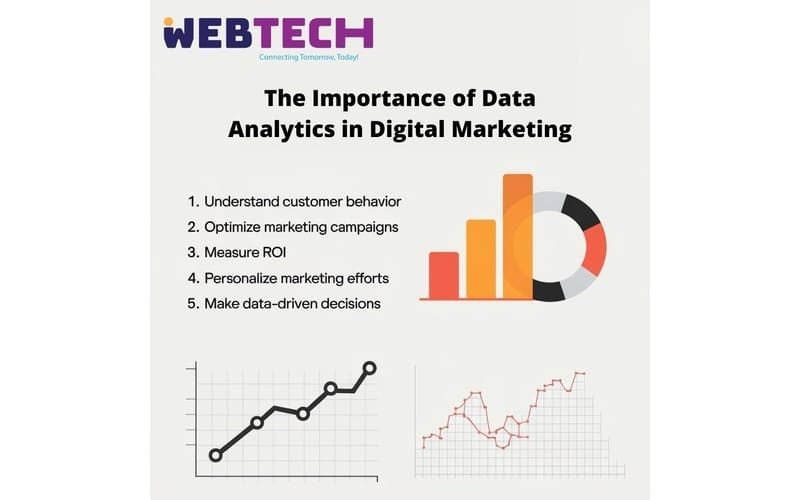
The Importance of Data Analytics in Digital Marketing

The Importance of Data Analytics in Digital Marketing

Data Analytics In Digital Marketing

In today’s fast-paced digital landscape, data analytics has become a cornerstone for successful digital marketing campaigns. Businesses are constantly looking for ways to stay ahead of the competition, and leveraging data-driven insights is key to maximizing the return on investment (ROI). In this blog, we will explore the importance of data analytics in digital marketing, highlighting how it can transform your strategies and drive growth.

1. Understanding Your Audience

One of the most significant benefits of data analytics in digital marketing is gaining a deep understanding of your target audience. Through tools like Google Analytics, businesses can track user behavior, preferences, and demographics. This information allows marketers to create highly personalized and targeted campaigns, ensuring their messages reach the right people at the right time.

2. Improving Campaign Performance

With the help of data analytics tools, digital marketers can monitor the performance of their campaigns in real time. This allows for quick adjustments to marketing strategies based on key performance indicators (KPIs) such as click-through rates (CTR), conversion rates, and bounce rates. By understanding what works and what doesn’t, marketers can optimize their campaigns for better results.

3. Data-Driven Decision Making

In the age of big data, relying on gut feelings for marketing decisions is no longer enough. Data-driven decision-making ensures that all marketing efforts are backed by accurate insights. This reduces the risk of failure and increases the likelihood of success by using factual data to guide strategies. Businesses can analyze trends, customer preferences, and market changes to make informed decisions that drive ROI.

4. Enhancing Customer Experience

A personalized customer experience is key to building brand loyalty. Data analytics helps marketers understand their customers’ journeys, from initial interaction to conversion. With this data, businesses can improve user experience (UX), delivering relevant content, offers, and messaging at each touchpoint. A better experience leads to higher customer retention and increased lifetime value.

5. Predictive Analytics and Future Trends

Predictive analytics is a powerful tool that allows businesses to forecast future trends based on historical data. By using machine learning algorithms and data analytics, marketers can anticipate customer behaviors, market shifts, and emerging trends. This enables businesses to stay ahead of the curve and proactively adjust their strategies to meet future demands.

6. Optimizing Marketing Spend

Data analytics helps businesses optimize their marketing budgets by identifying which channels, campaigns, and strategies yield the highest ROI. By focusing on the most effective marketing activities, companies can allocate resources more efficiently and reduce wasted spend. This leads to cost-effective digital marketing strategies that maximize results.

7. Competitive Advantage

Businesses that effectively use data analytics have a competitive edge. Companies can stay ahead of their competitors with a clear understanding of market trends, customer preferences, and campaign performance. Data-driven insights enable businesses to pivot quickly, seize new opportunities, and refine their strategies to outperform others in their industry.


Data analytics is no longer a luxury but a necessity for any digital marketing strategy. By harnessing the power of data, businesses can gain valuable insights, optimize campaigns, improve customer experiences, and drive growth. At WebTech Digital Marketing, we specialize in using advanced data analytics to help our clients achieve measurable results.


Contact us today to learn how we can transform your digital marketing efforts through data-driven strategies

Why LinkedIn Marketing is a Must-Have Strategy for Business Growth 

Why LinkedIn Marketing is a Must-Have Strategy for Business Growth

LinkedIn Marketing Strategy

In today’s digital landscape, businesses are constantly seeking effective strategies to scale and grow. One platform that stands out for B2B networking and lead generation is LinkedIn. With over 930 million professionals worldwide, LinkedIn offers unparalleled opportunities for businesses to connect with potential clients, build brand authority, and ultimately, drive business growth. In this blog, we’ll explore why LinkedIn marketing is essential for any business strategy and how you can leverage it to attract and convert potential clients.

Why LinkedIn Marketing Strategies?

1. Access to a Professional Network

Unlike other social media platforms, LinkedIn is specifically designed for professionals. The audience here is not just scrolling for entertainment; they are actively looking for valuable content, business connections, and services. This gives your business the perfect environment to target key decision-makers and industry influencers who are genuinely interested in what you have to offer.

2. Boost Brand Authority

Your LinkedIn profile is not just an online resume; it’s an opportunity to build brand authority. By consistently sharing high-quality content, thought leadership posts, and case studies, you position yourself and your business as an expert in your industry. Over time, this boosts your credibility and attracts a larger audience who will trust your brand when it comes to purchasing decisions.

High-ranking keyword: Boost brand authority on LinkedIn

3. Advanced Targeting Options in LinkedIn Lead Generation

LinkedIn’s advertising platform offers advanced targeting capabilities. You can pinpoint potential clients based on their job title, company size, industry, and even specific skills. These granular targeting options mean that your ads and content will be seen by people who are more likely to convert, making LinkedIn an excellent tool for B2B lead generation.

4. Building Long-Term Client Relationships

LinkedIn is a relationship-driven platform. It allows you to build meaningful connections over time through personalized messages, engagement on posts, and value-driven content. Whether you’re offering insights through articles or engaging in group discussions, LinkedIn enables you to nurture leads and convert them into loyal clients.

5. High Organic Visibility

Unlike Facebook and Instagram, where organic reach is declining, LinkedIn offers better organic visibility, especially for businesses. When you publish content on LinkedIn, it can reach a broader audience without having to rely heavily on paid advertising. Regular updates, articles, and interactions with your network can help your business gain organic traffic and grow your audience without exhausting your budget.

6. Effective Personal Branding for Business Owners

As a business owner, leveraging LinkedIn to enhance your brand is crucial. Sharing your business journey, challenges, and successes makes your brand more relatable and human. Potential clients are more likely to trust and engage with businesses that have a face behind the brand. Your brand, combined with your company’s values, can serve as a powerful marketing tool.

How to Optimize LinkedIn for Business Growth

Final Thoughts

In today’s competitive business environment, LinkedIn marketing is no longer optional—it’s essential for sustainable growth. Whether you’re looking to increase brand authority, generate qualified leads, or build long-term client relationships, LinkedIn offers the tools and network to achieve your business goals. By strategically using LinkedIn, you can attract potential clients and position your brand for continuous growth.


Looking for a LinkedIn Marketing Agency? At Webtech Digital Marketing Services, we specialize in crafting customized LinkedIn marketing strategies that help businesses like yours grow. Contact us today to learn how we can elevate your LinkedIn presence and drive more leads.

8 Ways to Boost Your Instagram Engagement with Stories and Reels

8 Ways to Boost Your Instagram Engagement with Stories and Reels

Boost your Instagram Engagement

In the ever-evolving landscape of social media, Instagram remains a powerhouse for brands, creators, and influencers to connect with their audiences. But simply posting isn’t enough anymore. To truly boost your Instagram engagement, you need to take advantage of its dynamic features—particularly Stories and Reels. Here are eight effective ways to use these tools and boost Instagram organically, ensuring that your content stands out.

1. Consistency is Key

To boost Instagram engagement, maintaining a consistent presence is essential. Regularly post Stories and Reels to keep your audience engaged and anticipating your content. Stories disappear after 24 hours, but they offer real-time insights into your life or brand, while Reels live on your profile and can go viral, providing longer-lasting reach. Aim for at least 3-5 Stories daily and 2-3 Reels weekly.

2. Use Polls, Questions, and Quizzes in Stories

Interactive features like polls, quizzes, and questions in Stories encourage direct interaction. When your audience feels involved, your Instagram engagement skyrockets. These tools not only make your Stories more engaging but also give you valuable feedback or insights from your followers. Polls, for instance, are a quick way to get opinions, while quizzes test your audience’s knowledge, leading to fun interactions.

3. Leverage Trending Music and Challenges in Reels

To boost Instagram engagement using Reels, stay updated with trending music and challenges. Instagram’s algorithm tends to favour Reels that incorporate popular songs or memes, helping you reach a broader audience. You can put your own creative twist on viral challenges, which will resonate more with your audience, improving your chances of getting more views and interactions.

4. Use Hashtags Strategically

Hashtags are still a powerful tool to increase Instagram engagement organically. Using 3-5 relevant hashtags in your Stories or up to 30 in your Reels can make your content discoverable to users interested in specific topics. Avoid overused hashtags and focus on niche, trending ones that directly relate to your content, boosting your visibility without drowning in a sea of competition.

5. Post Behind-the-Scenes Content

Audiences love to see the human side of a brand or influencer. Use Stories to post behind-the-scenes content to give followers an exclusive look into your process or day-to-day activities. This creates a more personal connection and will boost your Instagram engagement by making your audience feel like insiders. Authentic, raw moments in your Reels can have a similar effect, showcasing a more relatable side of you.

6. Time Your Posts Right

Posting at optimal times is critical when trying to boost Instagram engagement. Research when your audience is most active and schedule your Stories and Reels accordingly. For example, most users are active in the early morning, late afternoon, and late evening. Posting during these periods will help ensure maximum reach and interaction.

7. Collaborate with Influencers for Brands

Collaborations on Reels and Stories can significantly increase Instagram engagement organically. Partnering with influencers, brands, or creators within your niche allows you to tap into their audience. By co-creating content, such as a joint Reel or a Story takeover, you gain more visibility while sharing engaging content with your current followers.

8. Include Strong CTAs (Call-to-Actions)

Whether you’re using Stories or Reels, always include a call-to-action. This could be a swipe-up link in your Story (if you have over 10k followers), asking followers to comment, share, or tag a friend on your Reels. A strong CTA encourages followers to engage directly with your content, helping you get more engagement on Instagram with each post.

Final Thoughts

Using Stories and Reels effectively can transform your Instagram presence, helping you boost Instagram engagement and expand your reach. By staying consistent, leveraging trends, and creating interactive content, you’ll increase Instagram engagement organically while fostering a loyal, engaged audience.


At WebTech Digital Marketing Service, we specialise in strategies like leveraging Instagram Stories and Reels to help boost your Instagram engagement and grow your profile organically. Our tailored approach ensures your content reaches the right audience, driving interaction and maximising your social media presence. Let us help you increase Instagram engagement and take your profile to the next level!

How User Experience (UX) Design Elevates Your Website’s Conversion Rates

How User Experience (UX) Design Elevates Your Website's Conversion Rates

In today’s digital world, where we’re constantly bombarded with options, your website is often the first and sometimes the only chance you have to make a lasting impression. But it’s not just about getting visitors to your site—it’s about keeping them there and making them want to engage. That’s where user experience (UX) design comes in. A good UX doesn’t just make your site look nice; it turns casual visitors into loyal customers. Let’s talk about how focusing on UX can directly boost your website’s conversion rates and why it matters so much.

1. First Impressions Last Longer Than You Think

Have you ever clicked on a website and immediately thought, “This isn’t for me”? You’re not alone. We’re all guilty of making snap judgments, and online, these decisions happen in less than a second. A thoughtfully designed UX helps you make that critical first impression count. Clean layouts, easy navigation, and a sense of trust will make your visitors stick around. If your site is cluttered or hard to navigate, they’ll bounce, and you’ve lost a potential customer before you even had the chance.

2. Guiding, Not Pushing: Seamless Navigation

Think about walking into a store where you know exactly where everything is. It’s easy, it’s pleasant, and you’re likely to come back. A website should feel the same. When your visitors can find what they need effortlessly, they’re more likely to explore further and engage. UX design ensures that navigation feels intuitive. It’s not about overwhelming users with endless options—it’s about making sure they know exactly where to go and how to get there. This small step makes a huge difference in whether or not they convert.

3. Mobile: The New Normal

Let’s be real—most of us browse on our phones these days. So, if your site isn’t optimized for mobile, you’re missing out on a huge chunk of potential customers. But mobile UX isn’t just about shrinking your desktop site to fit a smaller screen. It’s about designing an experience that feels native to mobile users—smooth scrolling, big touch-friendly buttons, and layouts that don’t require users to pinch

4. Making Choices Simple

Ever been to a restaurant with an overwhelming menu and struggled to pick something? Decision fatigue isn’t just limited to dining; it’s a real issue on websites too. The more complicated the user journey, the more likely it is that visitors will abandon their cart or leave without taking action. Good UX helps reduce this by simplifying choices and highlighting the most important actions. Whether it’s a one-step checkout or a clear, bold call to action, the smoother the path, the higher the chances of conversion.

5. Trust: It’s Earned in Milliseconds

Trust is the invisible force behind every conversion. You might not even realize it, but we all subconsciously judge how trustworthy a website feels in those first few seconds. A professional design, a secure checkout process, and transparent messaging all go a long way in building trust with your users. And once that trust is established, visitors are far more likely to take action—whether that’s making a purchase, signing up for a newsletter, or booking a service.

6. Make It Personal, Make It Relevant

Have you ever been on a site that greeted you by name or recommended products you were actually interested in? That’s the magic of personalization, and it’s a key component of great UX design. By understanding user behavior and preferences, you can tailor content, product suggestions, and offers that resonate with each visitor. It’s like having a personal shopping assistant who knows exactly what you want. Personalized experiences make users feel valued and understood, which naturally leads to more conversions.

7. The Need for Speed

We all hate waiting—especially online. If your website takes longer than a few seconds to load, chances are, users will abandon it. Page speed is a massive part of UX design, and every second counts. The faster your site loads, the better the experience, and the more likely visitors are to stick around. Optimizing images, reducing server requests, and compressing code are just a few ways to speed up your site. In the end, a faster site equals happier users, which leads to better conversion rates.

8. Accessibility Isn’t Optional

Here’s something that’s often overlooked: accessibility. Not everyone experiences the web in the same way, and inclusive design makes sure that your site is usable by as many people as possible. Whether it’s adding alt text for images, ensuring your site works with screen readers, or making your buttons keyboard-friendly, these small changes make a big difference. When your website is accessible, you’re opening it up to a larger audience, and that translates directly into more potential customers.

9. Delight: The Extra Mile That Converts

Sometimes, it’s the little things that make the biggest difference. Thoughtful UX design isn’t just about function; it’s also about creating delight. Micro-interactions like a subtle animation when you click a button, or instant feedback when you fill out a form, can make the experience feel more enjoyable. These touches create a positive emotional response that sticks with users, making them more likely to convert—and return.

5 Digital Marketing Trends in India 2024 To Keep Your Eye On

5 Digital Marketing Trends in India 2024 To Keep Your Eye On

Introduction

Now we are in the second quarter of 2024, it is very essential to stay updated on the recent trends in advertising in today’s era to make sure the success and growth of your brand in getting fresh consumers.

and businesses battle to stay appropriate, grasping and adjusting to recent trends in advertising become most critical. So, we analyze the future of digital marketing, exploring the tools and strategies that will set the stage for success in the years to come.

1. Role of AI in digital marketing ( Artificial intelligence )

AI is no longer an unfamiliar concept in digital marketing; it’s already rapidly becoming involved in several marketing tools and strategies. The role of AI in digital marketing is providing 24/7 customer support to personalized ad targeting and creating content, AI is automating tasks and making Digital marketing more logical and effective.


In India, data and AI are projected to attach a staggering 450-500 billion Dollars to the GDP (Gross domestic product ) by 2025. it is a promising trend to look ahead to in 2024.

2. Voice Search Optimization Trends

Unlike the standard search where manually typing is the doorway to conducting searches, the search by voice technology that has helped the advances of smart speakers and voice assistants like Alexa, Siri, and Google Assistant has produced the voice search questions to go up.


In 2024, the bulk of Google searches online done in India use voice. To business the conversation should be friendly written content becomes quite short and tail-tail keywords Language changes into more conversational events, that people use to express it by their voice. companies for example, WEBTECH a Digital Marketing company based in Pune, are already serving clients to adopt this change and earn a position where their content can run a best voice search.

3. Personalized Customer Experiences

In digital marketing, personalization is a strategy that customizes content to particular buys. It’s based on their taste and actions when interacting with a brand, and it can compromise data like past activities, past purchases, email interactions, social media engagement, and site visits. This kind of Digital marketing is more effective than broad content and can increase brand recall, customer loyalty, and sales.


Examples of personalization in digital marketing are product recommendations in e-commerce, showing related products and services on the product/service page, and customized call center responses for repeat customers. If you want to learn more about personalized Digital marketing and you are living in Pune, you can enroll in the best digital marketing course in Pune.


well, personalization only works when it’s relevant and useful to the user. It’s important to make sure that any personalization strategy you execute is not creepy or offensive. It’s also a good idea to invest in software that can handle complex customization marketing, and merge with existing setup. PEPSI’s “Share A PEPSI” campaign, which puts common first names on its can, is a nice illustration of a successful personalized enterprise.

4. Video Marketing

Video marketing has been on the rise for some years, and it continues to be a superior trend in the digital marketing domain. With the popularity of platforms like Facebook, YouTube, and Instagram Reels, video has become a necessary tool for brands to attract and engage with their audience.


To create a successful video, you have to focus on an engaging storytelling approach, Using high-quality visuals, and optimizing video for current trends and audience preference. These experiences allow brands to create interactive and unforgettable experiences that captivate and convert audiences. For example, a virtual reality tour of a resort can give potential guests a practical preview of the space and amenities, increasing the chance of bookings.


In conclusion, video marketing remains a hot trend in the digital marketing landscape. By incorporating immersive video experiences and leveraging live video streaming, brands can successfully attract and engage their user, eventually driving business growth.

5. Social Media Marketing

Successful companies’ digital marketing efforts will continue to depend totally on social media. Expect video, Facebook, Instagram, live streaming, and podcasts to influence the list in the upcoming years. Facebook will not go anywhere; it’s here to stay. LinkedIn will grow significantly, usually as influencers use it to increase their opinion. This year, when it comes to influencers, it will be the year of experts with fewer but more loyal followers. What matters is the niche, and those who can grasp control of an untapped market with small to no competition will be ahead of the troop.

How to identify an untapped market for Business ?

Identify untapped markets: One of the biggest opportunities comes in identifying and tapping into untapped markets that have been failing to notice or underserved by your competitors. These markets frequently have certain needs or desires that are not being met, giving a chance for you to enter and organize a strong presence with the help of digital marketing and social media marketing. For example, a healthy food industry may identify an untapped market of buyers who are looking for gluten free, organic made snacks. By catering to this particular segment, the business can gain a competitive advantage and attract a trusted consumer base.

Conclusion

In the ever-evolving environment, staying updated on the latest digital marketing trends is very important for every brand’s success. From prioritizing first-party data to accepting short video content ( Reel ) and leveraging Augmented reality (AR), Digital marketers have a multitude of tools at their distribution to engage their consumers authentically and responsively. 

By picking together stories that resonate with Gen-Z, championing socially aware campaigns, and controlling user-generated content, brands can also build trust and encourage immersive knowledge. The future of the consumer experience lies in content personalization driven by Artificial intelligence, AI, proposal-tailored product recommendations, and personalized Digital marketing campaigns that honestly connect with audiences on a very deep level.

Why is Google Business Profile Important for Your Business?

Why is Google Business Profile Important for Your Business?

Google My Business


If you have not created or submitted your Google Business Profile (earlier Google My Business), then you should, because it’s free of cost! More than 90% of web searches are done on Google. These users are searching for multiple products, services, or information about a specific topic. Not having a GBP ( Google Business Profile ) listing or having an unclaimed business profile can hurt you in multiple ways. Having wrong data, not being able to respond to negative reviews and not showing up below paid ads on Google Maps are just a few of the troubles. So, what are the most important benefits of GBP?

Boost Your Local Google Search Presence

Setting up your Google Business Profile is one of the easy and most useful ways of setting your business up to be found online. More and more search queries are becoming geographically particular and Google’s algorithms have been developed to think about user intent.


You’ve very likely done a Google search at some point such as, ‘best places to eat near me’, if so then you’ll notice that Google returns a list of three locations where you can eat based on your present location. The three businesses that have shown as a result of your search query have a GBP (Google Business Profile) page and are one step closer to attracting you as a buyer.


If these places to eat did not have a GBP (Google Business Profile) page then they would not have shown. Think about this in the subject of your business, whatever product or service you may be selling. How can local searches value your business and what might you be missing out on without one?


As Google makes regular different changes to its algorithms, if you want to Boost your local marketing and get found in local search result you need to have a GBP (Google Business Profile) listing and be optimizing it on a regular basis

Best Way to Optimize Your Google Business Profile

1. Choose a set of keywords

At the very start, you need to think about what keywords (relevant keywords) you want to grow your business’s visibility on Google Maps. If you are a doctor in pune, you probably want to be visible top on Google for keywords like doctor in pune, best clinic pune, doctor near me, etc.


We know that finding the best keywords is difficult and it takes up your time, so at webtech (which operates multiple businesses worldwide) we do all the analysis for you and match the words to your business. All you have to do is provide us with just one word. 🙂

2. 4 Quick tips to Have a Great Google Business Profile

  • Add very relevant photos, videos and make sure to name them properly.
  • Add your Google business profile to your website.
  • Ask your customer for reviews and respond to all reviews, not just positive reviews.
  • Make sure all your business information listed is correct.

3. Monitor your business

Systematically monitoring the visibility of your business and reply to changes is one of the critical components of the whole process of improving the visibility of your business profile online.


You need to understand how your business and competitors behave to your changes.


It would be great if you also reacted quickly to the steps taken by your competitors, who will want to overtake you at all costs and leave you far behind in the Google search results.

Best Practices

Every businesses should follow these best practices:


Consistency in Business Info: Businesses should make sure that their info is correct and consistent across all online channels, including website and social media accounts.


Regular Updates and Posts: Regularly updating with new photos, posts, and updates can help your businesses stay relevant and occupied with your customers.


Encouraging Your Customer Reviews: Positive customer reviews can help your businesses to build trust and reliability. Encouraging your customers to leave a review on the profile can help improve your online presence.


Responding to Your Customer Reviews: Responding to customer reviews, both if it’s positive or negative, shows that the business is listening and cares about your customers’ point of view.


Google My Business is a very valuable tool that can help your small businesses improve  online presence, increase brand awareness, and better engage with your customers. By following best exercises and regularly updating the profile, your business can increase the chances of appearing at the top of google local search results and ultimately increase sales as well. To fully optimize your profile contact us today.